
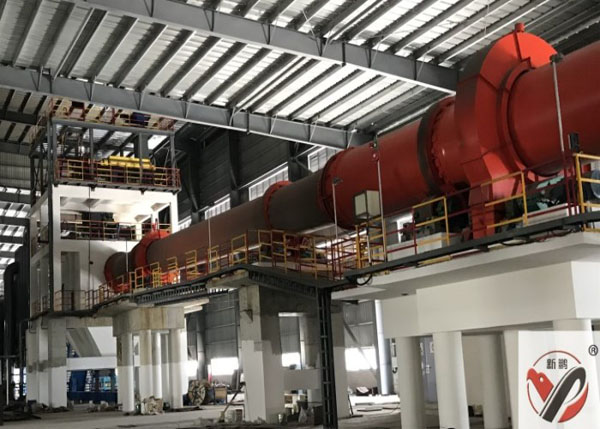
Ceramic production line
Ceramic particle sand is a new material that has emerged in recent years, with a wide range of raw material sources. Aluminum vanadium soil, fly ash, clay, shale, garbage, coal gangue, biological sludge, riverbed mud, and so on can all be used as raw materials. Ceramic particles have the characteristics of light bulk density, high strength, thermal insulation, fire resistance, and thermal insulation. They have high seismic and compressive strength, are non-toxic, have no radioactive side effects, are environmentally friendly and energy-saving, ...
Sales Service Hotline:0086-513-88380559
Product Details
1. Overview
Ceramic particle sand is a new material that has emerged in recent years, with a wide range of raw material sources. Aluminum vanadium soil, fly ash, clay, shale, garbage, coal gangue, biological sludge, riverbed mud, and so on can all be used as raw materials. Ceramic particles have the characteristics of light bulk density, high strength, thermal insulation, fire resistance, and thermal insulation. They have high seismic and compressive strength, are non-toxic, have no radioactive side effects, are environmentally friendly and energy-saving, and have strong construction adaptability. They are widely used.
No matter what raw materials are used, the ceramic production line generally adopts the production process of raw material homogenization, granulation, roasting, and cooling. According to the type and characteristics of the raw materials, the granulation process can include:
1. Plasticity process: suitable for clay and clay raw materials, its process: clay → plasticization, homogenization → roller granulation → roasting → cooling → finished product.
2. Mud balling process: suitable for fly ash or other powdered raw materials, the process is: fly ash → mixing and homogenization → balling disc granulation → roasting → cooling → finished product.
3. Grinding and ball forming process: suitable for raw materials such as shale, mudstone shale, and coal gangue. The process is as follows: shale → drying → grinding → pre wetting → ball forming disc granulation → roasting → cooling → finished product, with additives added.
4. Crushing (dry process) technology: suitable for shale and other raw materials, its process: shale → crushing and grading → roasting → cooling → finished product.
5. Fuel: Depending on the local fuel supply situation, rice bran, bituminous coal, heavy oil, or natural gas can be used.
2、 Various ceramic particle production processes
1. Sludge and clay ceramic production line
There are several methods for treating sludge, such as land reclamation, landfill, incineration, and land use, but all of them have many problems. If all the sludge from the sewage treatment plant is treated by landfilling, it not only incurs a large amount of treatment costs, but also causes secondary pollution to the environment. Using sludge to produce ceramic particles can not only replace clay in firing ceramic particles, save land, and turn waste into treasure, but also achieve high-temperature sterilization and solidification of heavy metals, avoiding pollution.
Clay ceramic particles are made from clay with suitable composition as raw material. When the composition is not suitable, other materials need to be added, processed into granules, and then expanded by high-temperature combustion of coal powder to form artificial lightweight aggregates.
Clay ceramic particles have the characteristics of light bulk density, high strength, thermal insulation, fire resistance, and thermal insulation. They have high seismic and compressive strength, are non-toxic, have no radioactive side effects, are environmentally friendly and energy-saving, and have strong construction adaptability.
Process description
After the car transports the sludge and clay into the factory, they are stored in the shed for natural drying for a period of time, and then transported to their respective silos by forklifts. A plate feeder is installed under the clay silo to send the clay to a roller toothed crusher for crushing. Multiple roller toothed crushers can be set up to reduce the particle size of the clay, which is then sent to a double shaft mixer. The sludge also enters the double shaft mixer through the screw conveyor under the silo. The sludge and clay are thoroughly mixed and stirred together in a double shaft mixer, and then sent to the aging yard for storage.
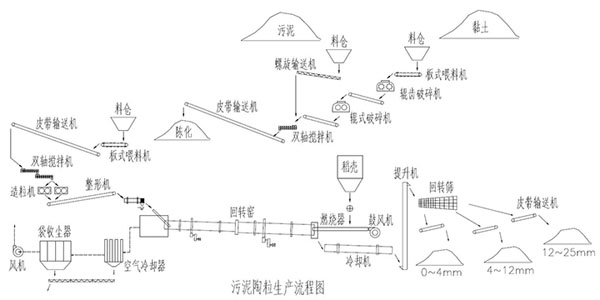
The aged mixture is sent to the silo by a shovel truck, and then mixed by a double shaft mixer before being sent to a roller granulator for extrusion granulation. The produced granular material balls are transported by a belt conveyor to a shaping and screening machine. After rounding, small particles are screened out, and qualified granular balls are sent to a double tube plug-in rotary kiln for preheating and roasting. The fired ceramic particles are cooled by a cooling machine and then divided into three specifications of 5mm, 15mm, and 25mm by a rotary screen. They are stored in the yard and bagged before shipment. The natural air used to cool the ceramic particles in the cooling machine is heated to 500 ℃ and enters the rotary kiln for auxiliary combustion, which can save a lot of fuel. Rice husk or other types of fuel can be used, and the crushed fuel is sent into the rotary kiln for combustion by a high-pressure fan. The high-temperature flue gas containing dust at the kiln tail enters the air cooler for cooling, and then enters the bag filter for purification before being discharged.
2. Brief description of the process flow of fly ash ceramic particles
Fly ash sludge ceramic particles are made by mixing fly ash, sludge, and clay. Fly ash is stored in a steel plate circular warehouse, unloaded by a rigid impeller feeder under the warehouse, measured by a belt scale, and sent to a double shaft mixer; The sludge entering the factory is piled up in a rainproof shed and stored for a period of time. After evaporating some of the water, it is sent to the sludge bin by a shovel truck and then sent to the double shaft mixer through the screw conveyor under the bin; The clay entering the factory is fed into the roller toothed crusher through a plate feeder, and after crushing, it also enters the double shaft mixer.
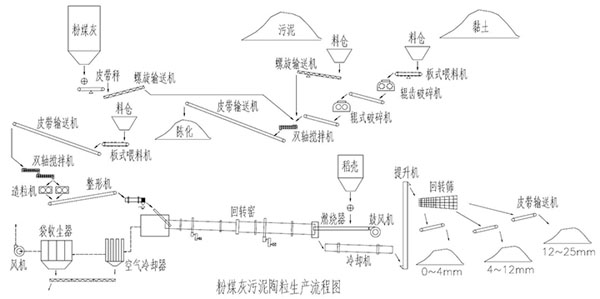
Fly ash, sludge, and clay are thoroughly mixed in a double shaft mixer, and after being evenly mixed, they are sent to the aging yard. The aging time is 15-20 days, and then it is sent by a shovel to a double shaft mixer for dispersion and mixing. After that, it is sent to a roller granulator, and the produced granular material balls are sent by a belt conveyor to a shaping and screening machine. After rounding, small particles are screened out, and qualified granular balls are sent to a double tube plug-in rotary kiln for preheating and roasting. The fired ceramic particles are cooled by a cooling machine and then divided into three specifications of 5mm, 15mm, and 25mm by a rotary screen. They are stored in the yard and bagged before shipment. The natural air used to cool the ceramic particles in the cooling machine is heated to 500 ℃ and enters the rotary kiln for auxiliary combustion, which can save a lot of fuel. Rice husk or other types of fuel can be used, and the crushed fuel is sent into the rotary kiln for combustion by a high-pressure fan. The high-temperature flue gas containing dust at the kiln tail enters the air cooler for cooling, and then enters the bag filter for purification before being discharged.
3、 Scale of ceramic particle production line
We can provide general contracting projects for ceramic particle production lines with an annual output of 15000m3/a, 25000m3/a, 35000m3/a, 50000m3/a, and 100000m3/a
Technical Specifications
Previous:There is no more.
Next:There is no more