Key points to understand when using a side cantilever stacker
Release time:2024-09-10
Views:
Author:admin
When applying a side cantilever stacker, the following points need to be understood:
When applying a side cantilever stacker, the following points need to be understood:
**1、 Equipment structure and working principle**
1. Structural composition:
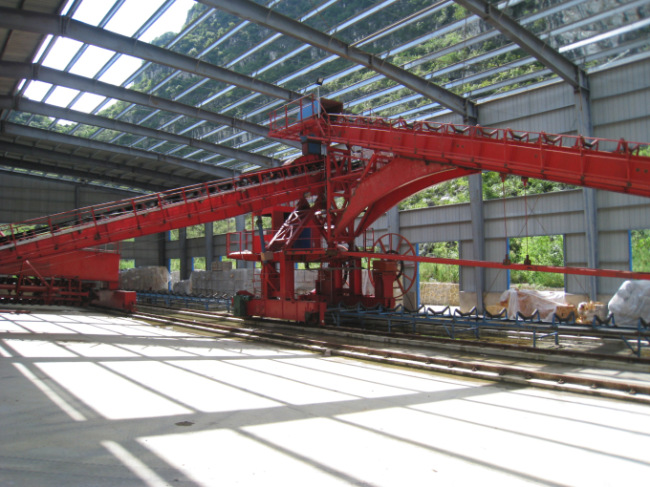
-The side cantilever stacker is mainly composed of a cantilever part, a walking mechanism, a rotating mechanism, a pitching mechanism, a conveying system, a control system, etc.
-Cantilevers are usually made of steel structures with conveyor belts installed on them to transport materials to the stockyard.
-The walking mechanism enables the stacker to move on the track, while the rotating and pitching mechanisms are used to adjust the position and angle of the cantilever.
2. Working principle:
-The materials are transported to the cantilever of the stacker through the feeding equipment (such as a belt conveyor), and then evenly stacked on the stacking yard with the rotation and movement of the cantilever.
-The control system of the stacker can automatically adjust the position and angle of the cantilever according to the preset stacking shape and height, in order to achieve efficient stacking operations.
**2、 Operation and Control**
1. Operation process:
-Before operating the side cantilever stacker, it is necessary to conduct equipment inspection to ensure that all components are functioning properly.
-Start the walking mechanism of the stacker and move it to the stacking position.
-Adjust the rotation angle and pitch angle of the cantilever according to the stacking requirements.
-Start the conveying system and begin the stacking operation.
-During the stacking process, it is necessary to closely monitor the operating status of the equipment, adjust parameters in a timely manner, and ensure the quality and safety of the stacking.
2. Control system:
-Side cantilever stackers typically use advanced control systems, such as PLC control systems or computer control systems.
-The control system can achieve automated operation of the stacker, including control of movements such as walking, turning, pitching, and conveying.
-The operator can operate the stacker through the control panel or remote control, and can also monitor the real-time operation status of the equipment through the monitoring system.
**3、 Safety precautions**
1. Equipment inspection:
-Before each use of the stacker, a comprehensive equipment inspection must be conducted, including mechanical components, electrical systems, hydraulic systems, etc.
-Check for any damage or looseness in key components such as cantilevers, conveyor belts, and walking mechanisms to ensure the safety and reliability of the equipment.
2. Safety protection:
-The stacker should be equipped with complete safety protection devices, such as guardrails, emergency stop buttons, limit switches, etc.
-Operators should wear personal protective equipment correctly when operating the stacker, such as safety helmets, safety belts, protective gloves, etc.
3. Operating standards:
-Strictly follow the operating procedures and do not operate in violation of regulations or change equipment parameters without authorization.
-During the stacking process, it is important to observe the surrounding environment and avoid collisions with other equipment or personnel.
-When there is a malfunction or abnormal situation with the equipment, the operation should be stopped immediately and maintenance personnel should be notified for inspection.
**4、 Maintenance and upkeep**
1. Daily maintenance:
-Regularly clean the stacker to remove dust and debris from the surface of the equipment.
-Check if the tension of the conveyor belt is appropriate, and adjust it promptly if there is any looseness.
-Check the lubrication condition of each lubrication part and add or replace lubricating oil in a timely manner.
2. Regular maintenance:
-According to the equipment maintenance manual, regularly perform comprehensive maintenance on the stacker.
-This includes inspecting, repairing, and replacing mechanical components, inspecting and maintaining electrical systems, cleaning and changing hydraulic systems, etc.
-Regularly calibrate and debug the stacker to ensure the performance and accuracy of the equipment.
**5、 Application scenarios and selection**
1. Application scenarios:
-The side cantilever stacker is suitable for various bulk material yards, such as coal, ore, sand and gravel.
-It can be used in conjunction with other conveying and loading/unloading equipment to achieve storage, transportation, and loading/unloading operations of bulk materials.
2. Key selection points:
-When choosing a side cantilever stacker, factors such as the size of the stacking yard, material characteristics, and stacking requirements need to be considered.
-Select appropriate equipment models and specifications based on actual needs to ensure that the performance and efficiency of the stacker can meet production requirements.
-At the same time, factors such as equipment reliability, maintenance costs, and after-sales service should also be considered when choosing products with high cost-effectiveness.
Previous:There is no more.
Next:Methods to improve the efficiency and quality of belt conveyors
RELATED ARTICLES
-
-
Introduction to the key points of using plate feeder
2025-01-17
-
Key points to understand when using a side cantilever stacker
2024-09-10
-
Do a good job in maintaining the bridge scraper reclaimer
2024-10-26
-
What is the ceramic particle production line used for
2025-06-10
-
Methods to improve the efficiency and quality of belt conveyors
2024-10-08